
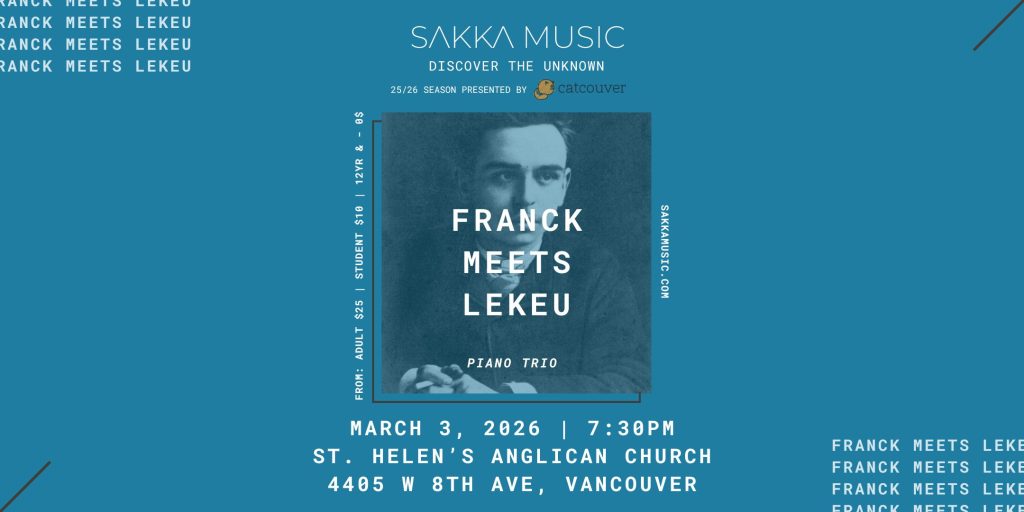
Program
Franck: Piano Trio in F-sharp minor, Op. 1 No. 1
I. Andante con moto
II. Allegro molto
III. Finale. Allegro maestoso
Intermission
Lekeu: Piano Trio in B minor
I. Lent – Allegro
II. Très lent
III. Très animé
IV. Lent – Animé
Judy Lou, cello
Andrea Tremblay, piano
Jeremy Ferland, violin
César Franck and Guillaume Lekeu embody a powerful lineage in French-Belgian chamber music. Franck’s early Piano Trio in F-sharp minor sets out the harmonic warmth and cyclical logic that became his hallmark. Lekeu, his devoted pupil, absorbed that language and transformed it into something intensely personal and strikingly modern for its time.
César Franck (1822–1890) Piano Trio in F-sharp minor, Op. 1 No. 1
Franck wrote this trio in his late twenties, at a moment when he was beginning to define the voice that would later blossom in works like the Violin Sonata and the Symphony in D minor. What stands out here is the germ of an idea that Franck would come back to throughout his life: cyclical form. Motifs introduced at the outset return—transformed—in later movements, binding the work with a sense of narrative inevitability.
The opening movement sets a serious, searching tone, with the piano’s rich textures supporting long, singing lines for violin and cello. A lyrical slow movement follows, intimate and vocal in character—Franck the organist is never far away, but so too is Franck the singer, shaping phrases with warmth and patience. The scherzo brings rhythmic vitality and sparkle, a foil to the surrounding gravitas. The finale gathers earlier threads, lifting the music toward a resolute close. Even in this “Opus 1,” Franck’s hallmarks are clear: glowing harmony, noble melody, and architecture that feels both spontaneous and carefully woven.
Guillaume Lekeu (1870–1894) Piano Trio in B minor
Lekeu’s life was heartbreakingly short—he died the day after his 24th birthday—but his music speaks with startling individuality. A passionate admirer and pupil of Franck, he carried the cyclical ideal forward while stretching melody and harmony to new expressive lengths. The B-minor Trio is one of his most personal statements: expansive in form, fearless in emotion, and unmistakably his own.
From the first pages, Lekeu writes in long breaths—melodies that unfold as if in a single, ardent gesture. Harmonies shade and pivot with a painter’s sensitivity to color, and the piano’s sonority envelops the strings in a warm halo. A central slow movement lies at the heart of the work: introspective, suspended in time, it invites listeners into Lekeu’s inner world with disarming honesty. The concluding movement intensifies the cycle’s memory—motifs reappear, reshaped, as if the music is remembering itself—before surging to a cathartic finish. If Franck offers architecture lit from within, Lekeu offers confession set to sound: long-lined, luminous, and unforgettable.
Make sure to follow us on social media and subscribe on YouTube, so you can continue to discover the unknown!